 April 26, 2009
Up-close and not so personal with the lions. They were obviously in a hunting-mode, but were probably distracted by the number of cars there. The down-side of Ngorongoro being a ‘contained ‘ area and this is during the low season. I can’t stand to imagine the number of vehicles there during the peak season (Sept-Dec)!
One of the females had actually stopped just next to JC and started to rub her face on our 4WD, right in front of our noses! Now tell me if that doesn’t make you feel all tingly!
 April 25, 2009
Certainly one of the most beautiful places on earth. I’ve said it before and I’m saying it again that pictures just don’t do justice to the place. Ngorongoro is somewhat ‘contained’ if compared to the Serengeti, and game-viewing wise, it is almost of no comparison to what we have experienced in the Serengeti. However, the landscape is worth raving about. Its beauty seen with the naked eyes is simply breathtaking.
Ngorongoro is essentially a unique crater known as a Caldera. A Caldera is the aftereffect of a volcanic collapse, an implosion rather than explosion and was formed some two million years ago. Ecologically it covers an area of 8,300 square kilometers with varied terrain and altitudes. These variations result in diverse and distinct habitats from grassy plains to mountain forest. The Crater itself measures an average of 18 Kilometers in diameter and approximately 700 meter vertical drop. Apart from being home to 25,000 large animals, it forms part of what is known as the Serengeti-Ngorongoro–Maasai Mara ecosystem. This ecosystem allows for the free movement of 1.5 million animals in their continuous search for green pastures known as the migration.
The crater is one of the prime areas to observe the endangered Black Rhino and Black Manned Lions. We saw a few lions up-close, and boy! it was sensational!
Entrance to Ngorongoro, view of and around the crater and a drive in the clouds into the crater:
View of the crater from our room and the restaurant, a bird rescued in front of our lodge (I almost accidentally stepped on her; she was flat on her back, looking rather dead, but still breathing)


Game -viewing around the crater:
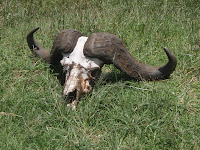
Buffalo skull found around Ngoitokitok springs:

 April 24, 2009
Almost like the Discovery Channel. We witnessed just part of the wilderbeest migration from the Southern Serengeti Plains to Moru Kopjes – plains with huge granite rock formations like mini mountains in the sea of grass.
The migration is on-going as the animals move seasonally from the wet season range (South and east plains) to the dry season habitat (north and back again).
The beest were everywhere…as far as your eyes can see. I was rendered speechless at the sheer number of them…possibly in hundreds of thousands! Here’s just an image* to give you a perspective of what it’s like. Unbelievable, no!
*P.S: The linked site is NOT the company we used for our safari trip.


